When Father Higgins heard I was calling from a bar, he recited the serenity prayer. When I begged him to repeat the blessings of salt and water, he thought I’d fallen off the wagon.
“No matter what you hear, I need you to keep repeating.”
Setting my phone on the table, I aligned the speaker with a glass. Checking my watch, I poured some table salt in, praying O’Brien still watered down his drinks.
The demon Naromach leaned over my shoulder.
“What’s all this?” He nodded toward the lines of shots.
Sweat trickled down my brow. “A drinking contest.”
Naromach sat. Candles flared. His talons tapped the Long Island Iced Tea at the end. “And this?”
“Something to wash it down.”
Naromach’s forked tongue licked his lips. “What’s at stake?”
“My soul.”
“We have your soul.”
“My soul, tonight.”
“And if you win?”
“A reprieve.”
Naromach smirked, “Agreed.” Without warning he swallowed the first shot.
I raced his demon constitution, downing my drinks with one hand, making the sign of the cross with the other.
Naromach was sipping his Long Island by the time I was halfway down the line. I kept on until he slurped the last drop. I was seeing two demons by the time he clutched his throat.
“What was in those shots?”
“Whiskey, but the water in that Long Island Iced Tea, was just sanctified by a priest.”
Naromach tried to grit his teeth, but his jaw dissolved before he could.
Hear no exposition, see no exposition, speak no exposition… or maybe just a little.
When I started writing, I was more concerned about what my characters were thinking than what they were doing. I wrote uneventful chapters, where the lead spent most of his time talking about his feelings. He rarely explored settings or exchanged dialogue with other human beings. His conflict was internal, his journey was cerebral, and his musings floated free from any kind of story structure.
My narrators weren’t passive observers, giving accounts of events as they happened, they were philosophers whose ideas read more like blog entries than stories. Their selfish nature was made apparent by an avalanche of I feel statements.
After some eye-opening criticism, my writing veered into another direction. I traded narration for strict description, play by plays of what my characters said and done. These stories read like screenplays converted from present tense into past tense. While my writing improved, it felt like it was missing something.
Compensating for my early first person sins, I’d let the plot reign over characterization. At their worst, my descriptions were so devoid of emotion they read like crime scene reports:
“One armed protagonist entered the room, shortly after sunset. He fired several rounds.”
My leads had lost their edge. I tried to smuggle some of their attitude into the dialogue, but it felt forced, especially when they weren’t sharing scenes with characters worth confiding in. I didn’t want to resort to soliloquy, so I tossed their clever musings into the waste bin.
It took a while before I realized I wasn’t taking full advantage of the medium. I was applying the limitations of movies to written stories, denying myself the tools that set the format apart.
Whether you’re writing in the first person or the third person, books let the reader see inside your characters’ heads. The trick is figuring out when to show what they’re thinking through their actions, and when to tell by getting beneath their skin.
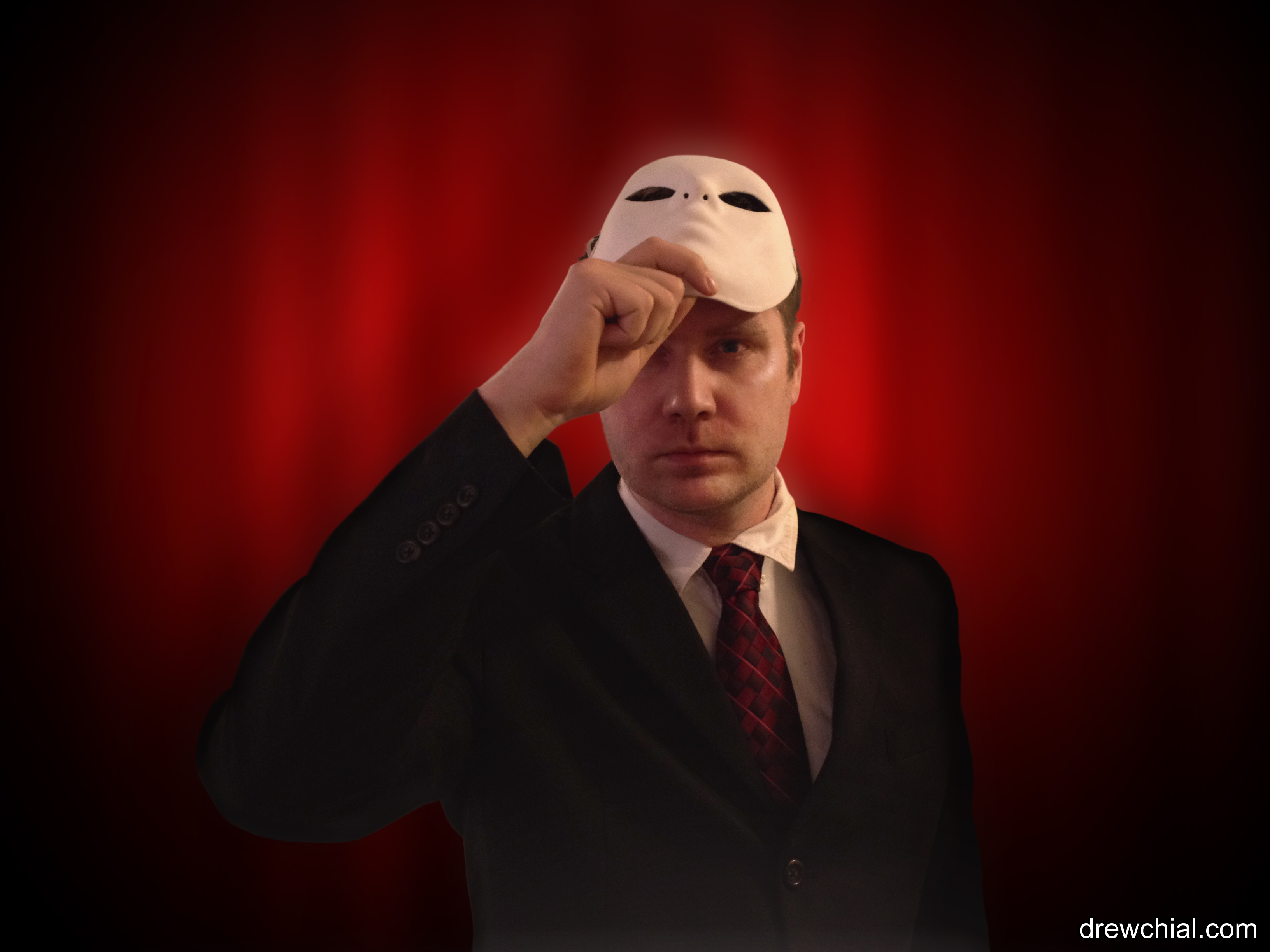
Internal monologues can take us beneath your hero’s mask
Sometimes Telling is the Best way to Show
Writers are told showing is preferable to telling. If given the option to reveal a character trait in a scene or through a narration, we’re supposed to write a scene. We’re told that narration is a form of telling that cheats the reader’s imagination out of its contribution. Writers shouldn’t ask readers to take the hero’s word for it, readers need evidence.
Subtext is the preferred tool for illustrating what a character is thinking through their actions, a way to launder information to the audience without the other characters noticing.
On the surface, your romantic leads sound like they’re arguing over which grocers they trust with their business, but they’re really talking about an entirely different set of trust issues. The scene isn’t about either one of them being embarrassed by a food seller’s practices, it’s about the couple’s mutual fear of being hurt.
There is a way to use telling to show. If a character’s thoughts are in stark contrast with their actions, it helps to run commentary over their scenes. Watch an episode of Dexter on mute and it’ll look like the title character is a working stiff who loves his family, until he flies off the handle and murders someone. Dexter’s internal monologue reveals his “dark passenger” lurks behind his every action. He makes the subtext explicit because he knows we won’t catch it.
If your character is a sociopath, they might not emote enough to reveal their motives. They could have a working knowledge of poker tells, they could keep their expression in check.
Characters are allowed to be shrewd with each other and outspoken with their audience. Their high society world might have them on their best behavior, but they can be shamelessly crass with the reader. We forge an intimate bond with characters who let us peek beneath their social graces and tell it like it is.
Reveal as much of the character as you can through their actions, but don’t deny them the occasional brazen declaration of their feelings.
Internal monologues are effective in moderation. Let them flow with the plot. Let them riff off of ongoing scenes. Don’t let them derail the action. If a chapter reads like a journal entry you’ve gone too far into telling territory. If you ever want to see a film adaptation give the director something to put on screen. Sometimes it’s better to put your lead’s internal monologue in their mouth. Give them one good friend to gossip with, so they don’t have to talk to themselves.
We need to see more of your character than they’re willing to show the world
Let Your Characters Gossip with Your Reader
In his book Robert’s Rules for Writing, Robert Masello says, “One of the greatest virtues of gossip is it gives us a chance, in a casual, nonjudgmental format, to check our own proclivities and attitudes against everybody else’s.”
Is it wrong to bully phone support into doing their job right? Do other people have scripted excuses they give to panhandlers? Does anybody else have friends who live-tweet their panic attacks?
We all want to know if we’re the only ones who do what we do or if our actions are part of a universal human condition.
As much as eavesdropping and observations can help your writing, so can accounts of other people’s wrong doing. The trick is to capture the spirit of these gossip sessions without quoting them verbatim.
It’s good to reveal characters’ relationships through scenes, but the medium allows them to gossip with the audience, to confirm hunches without the other characters knowing.
Why not give our leads a little too much wine and let their tongues hang loose?
Let them say things like, “How long have I been with my husband? Long enough to experience his entire sexual spectrum, from his premature ejaculations to his inability to perform.”
From scene to scene, this character’s mask tells the world they’re satisfied with their marriage, but we know different.
The narrator cuts us in on a dramatic irony, unknown to her husband. This insider information tints how we see the couple’s interactions, it foreshadows tragic outcomes. We get to chuckle at the false assumptions others make about the state of the narrator’s relationship, because we’re closer friends.
There are subtler ways to get this effect, but sometimes giving your audience a peek beneath your hero’s mask is the most entertaining one.
My favorite first person stories are littered with moments where the hero says something so shameless it makes my jaw drop, where I think, “I can’t believe they’re trusting me with this information,” where I mistake them for a real person.
It’s important to ground your story, to show as much of your character as you can, but indulge in telling what they’e thinking every so often.
Albert woke up in a hospital gown, on the floor of a small white cell. Rather than try the door, he sat up in the lotus position, waiting for the world to boot up.
Rubbing his eyes, Albert looked to the fluorescents, then to the shadow cast by the mattress. The brightness didn’t shift. Smoothing the pillowcase, he waited for the white balance to change. The fabric stayed beige.
Albert tapped his temple. When the H.U.D. didn’t show, he tapped it again. This had happened before he just had to remember how he’d fixed it.
Pinching the air, Albert waited for the search field to appear. The memory interface drew a blank. There were no folders, no windows, not even a floating pinwheel of death.
Turning around Albert wasn’t shocked to find a wall length mirror, but rather what he saw there. The lights in his eyes had been reduced to two tiny sparks, the same bland color as the florescent on the ceiling. There were no notifications, no pending messages, no emoticons. This was the first time Albert had seen the natural color of his eyes in a long time. The windows to his soul were wide open and what he saw was unsettling.
Despite the size of his cell, the world seemed so much larger than it had before.
Dr. Locke entered the viewing room behind the mirror. “What do you think?”
Dr. Walton shrugged, “He’ll be crying out for tech support in about five seconds.”
It takes a lot of positive reinforcement to support a writer’s ego. Flattery fades, while words of discouragement echo. It’s not that we don’t know how to take a compliment, it’s just that we lie for a living and we’re skeptical of everyone.
Praise for our writing feels like a put-on, something that dissolves upon cross examination. “What was your favorite part of my novel? What did you like most about the characters? Did you even finish it?”
Harsh criticism feels genuine, because it confirms our suspicions. “I knew that story came too easily. I should’ve outlined more. I should’ve shown it to more beta readers.”
What writers aspire to do is hard. We’re a generation trying to launch careers on Amazon while our competition gives everything away on Goodreads. It used to be that no one was buying what we were selling, now no one is taking what we’re giving.
One bad reaction invalidates a thousand compliments from family and friends, who we suspected were only feigning an interest to spare our feelings. A stranger’s insults resonate, because they have no stake in our wellbeing.
I can still quote the first negative comments I got online. They came from a message board where I’d previewed a few poems from what I’d thought was a collection worth publishing.
The first response read, “If you have a book coming out, then I’ll eat my hat.”
Enter the Anti-Muse. At the time, I had no idea how gentle he was being, that this was him on his best behavior. As I continued to share my work in public forums, the two of us became very familiar.
The Anti-Muse believes his tastes are universal. If something isn’t his cup of tea then the person who made it ought to shuffle off this mortal coil. It’s not enough for him to dismiss the author’s spark of inspiration, he needs to suck it right out of them.
Rather than leave others to separate the wheat from the chaff, the Anti-Muse burns the field down, planting seeds of doubt to spare the world from another crop of poets, bloggers, and self-publishers. When a budding author asks for advice, he tells them to quit. The Anti-Muse prides himself on his ability to quell artistic ambition.
I remember those first harsh reviews more than what I’d shared. That’s the problem with the Anti-Muse. He likes to linger.
Living with an Anti-Muse on Your Back
Once the Anti-Muse gets under your skin, he sets up shop, stirring up intrusive thoughts, flooding the imagination with bad memories. He needs your self doubt on hand so he can reference it at a moment’s notice.
The Anti-Muse has you writing slow, editing as you go, making you so self conscious about what you’re working on, you’re forgetting crucial details about the story to come. He has you overworking for simple statements, second guessing every line of description.
At first you worry your descriptions are too poetic, then you worry your verbs aren’t evocative enough. You use exaggerations to add emotional weight, catch yourself doing it, then resort to procedural accounts like you’re writing a police report. Your purple prose turn beige.
The Anti-Muse has you over researching your subject, then wondering if your dialogue is too technical, as if you dropped all this knowledge just to prove your knowhow. Then he has you gut every plot line that required any level of expertise.
When your imagination suggests a bold new direction, the Anti-Muse keeps you pressing on a familiar one. You play it safe, making sure everything you write feels familiar. Your characters speak in tired clichés, not because you lack an ear for dialogue, but because you lack the confidence to write your own.
Rereading your result, the Anti-Muse has you wondering if you should even bother editing. That’s his function. He’s a demon, sabotaging creative endeavors until the artist is ready to throw the towel in.
Dismissing the Anti-Muse
The good thing about encountering the Anti-Muse online is that he makes himself easy to identify. Like a desperate lawyer who knows the law isn’t on his side, the Anti-Muse makes appeals to emotion. He hates your art without offering a clear reason he thinks it’s wrong.
In some cases the Anti-Muse doesn’t know enough about the medium to offer constructive criticism, literary theory eludes him, he tears you down, because he doesn’t know how to tell you what to fix. He may not know art, but he knows what he hates.
In other cases, the Anti-Muse knows too much, but refuses to share his wisdom. He’s failed to make it on his own, now he resents anyone with similar aspirations. If he can’t be successful, why should anyone?
Either way, the Anti-Muse’s hostility is easy to dismiss, because you know there’s no sense in reasoning with it.
When I’m online, I tune the Anti-Muse out at the first signs of name calling, profanity, or the words “Sheesh” and “Bro.” I don’t put a spotlight on him when he’s heckling, because I know he only speaks in zingers.
Exploring forums on writing, there isn’t a day that goes by where I don’t see an angry know-it-all, who is only there to put newbies in their place, trash talking like the conversation is a match of Call of Duty. Examining their comment history, I find they’re terminally toxic, self-congratulating, flame war veterans.
Some people come across as the Anti-Muse by accident. They know their stuff, but refuse to cushion their candor. They’ll grade your writing, without a professor’s kindly classroom manor. They don’t have the patience to pay you compliments. They spot problems and dive right in.
Before you go dismissing critics based on their tone, see if they’ve gone to the trouble of citing examples. Did they use terms that seem like foreign jargon? Look up their lingo to see if they touched on tropes you use too often. Did they give suggestions for taking your story in another direction? If they hadn’t come off as smug, would you listen to the advice they’ve given?
Every screenwriter that came to speak at my school said the same thing about getting notes from producers: if a suggestion was based on an abstract feeling, the screenwriter ignored it. If a producer touched on something specific, their advice was always considered.
When it comes to taking criticism, developing a thick skin isn’t a writer’s only responsibility. Developing an ear for good feedback is more important.
A critic’s ability to articulate is what separates assessments from reactions.
“No one cares about you, so why the hell would they want to read your memoir?” Isn’t feedback worth paying attention to.
“Every character speaks with the same voice, same dialect, and same pop culture references. You need to make them more distinct so we know which one is talking.” Is feedback you can use.
Just remember, your work will never be universally loved. You will always be a hack to someone. Accept it and keep writing.
There’s a reoccurring phrase characters on Lost always shout when someone tells them that something is impossible:
Something about that stubborn declaration has always resonated with me. I find myself thinking it, every time someone tells me there’s no future in fiction, that I shouldn’t even bother, that I should leave the storytelling to some old Hollywood producers recycling the same franchises year after year.
I’ve received a lot of complaints about the howling translucent entity that’s taken up residence in the emergency wing. Based on the consensus that she is in fact a banshee, I’ve taken it upon myself to do some Wikipedia research.
In all my reading, I’ve found a banshee’s primary function is to warn of an impending death. Now that revelation must seem blood curdling to a family in an isolated cottage, but here in the ER she’s just redundant.
The way I see it, those mob goons buried one too many bodies in the forrest, and this banshee followed the crime wave back into the city, from meth factories to dark allies, until she hitched a ride with a couple of EMTs. She’d been orbiting the vortex of death until she got sucked into the big black pit of it.
She’s our problem now: wailing down corridors, bleeding through operating tables, distracting surgeons and horrifying patients, but what if she could be our solution?
My proposal is simple: if this apparition knows which patients are about to meet their end, why not make her part of the triage process? If a patient is doomed, there’s no reason they need stay on our list.
Until now we’ve treated patients based on the urgency of their issue, but if we’re absolutely certain there’s nothing to be done, aren’t we morally obligated to move on? If the banshee’s never wrong she’s not a pest, she’s a Godsend.
Writing for the web, I find it difficult to return to long form storytelling. Maintaining an online presence, my short stories always feel more relevant to hot button issues of the day. Working on a novel, I don’t have the instant gratification of ‘Likes’ and comments.
In his book On Writing, Stephen King recommends churning out a draft in three months. He says, if you wait any longer you’ll lose momentum. For writer’s trying to woo an audience on social media, this time frame is tough to maintain. Blog entries and short stories are speed bumps on our novel’s journey.
Returning to my work in progress, I’m often stumped. The characters aren’t as fresh in my mind. I know where the story is supposed to go, but the direction doesn’t seem as interesting. There’s a writer’s blockade around my inspiration. King’s curse comes true.
Usually I’d just give up and move onto the next bright shiny idea, that was before I’d stumbled onto a method to revive my manuscript. Now, rather than stick to my original outline, I give myself something new to look forward to. Not a crowd pleasing triumph, but a problem in need of solving, a plague on my characters’ houses. A big terrible event on par with George R.R. Martin’s infamous red wedding.
This new tragic twist wouldn’t betray the story, but it would be shocking enough to jump start my interest.
The Mind Explosion
Make a Bad Situation Worse
Rereading works in progress, I look for seismic activity. These tremors take the shape of character traits, details I’d put out there to make the character seem more real.
In The Book of Mirrors, I made Austin, the hero, a troubled teen who’d grown up into a successful author. For flavor, I mentioned that she used to have a compulsion to pluck out her hair. I wasn’t planting anything in the grand scheme of things, but when I got stuck something about that character detail became appealing.
In the story, Austin is brought on to ghost write a draft of a forged diary. The diary is supposed to be a cautionary tale to scare teenage girls away from sex, drugs, and the occult. The problem is it’s been stitched together from the real experiences of a dozen other contributors, each one with a background similar to Austin’s. This Frankenstein’s monster journal is so effective at drawing out the reader’s empathy, it gets under the skin of anyone who works on it.
I got stuck trying to figure out the best way to visualize Austin’s descent into madness. She’d spent the story writing in a mirrored room, a place her benefactor said would help Austin reflect on her life. I figured, he’d return to find she’d broken the mirrors and cut herself with the shards, but as I got closer to the scene, I felt like it was a copout, a cheap horror gag I’d seen several times before.
I was about to put the piece on the back-burner when a little voice inside of me said, “Wouldn’t it be terrible if the benefactor returned to discover Austin had plucked herself bald?”
My initial reaction was, “That somehow seems more insane than more traditional forms of self mutilation. If she’s that far gone, how will she come back from that?”
The little voice whispered, “Are you really sure you want her to come back from that?”
Those signs of seismic activity, I’d written subconsciously, steered me toward the emotional volcano at the heart of the story. All I had to do, was listen for the tremors and let it flow.
Mamet’s statement breaks down into three concepts: Goal, Motivation, and Conflict. If every character is motivated to act on their goals, there should be conflict, especially if their goal isn’t compatible with anyone else’s. This is how scenes reveal characters, advance the plot, and tip the scales of hope and dread
If the scale is tipped too far toward hope for too long, not only will the audience lose interest, so will you. If it’s tipped too far toward dread the story will be emotionally exhausting, to read and to write. The trick is finding the right balance, to create just enough tension to keep you and your audience engaged until the end.
Not everything that can go wrong in your hero’s life should go wrong, but your reader ought to think it’s a possibility. They need to believe you are a cruel God and that yours is a harsh reality.
I don’t use every tragic outcome that comes to mind, but I foreshadow as many of them as I can. This way, a happy ending feels like a well earned surprise. Trick your audience into thinking you’re telling a tragedy, then give them a victory.
God might forgive people in the moment, but writers should wait until the third act to decide their character’s fate.
I can come back to stories that I’ve sat on because I write with a loose plan, leaving space for bad shit to happen. Just as stories are born from “What if?” questions, so are plot developments. I ask myself, “What if this terrible development upset my hero’s plan?” If I decide the idea is too harsh, I dial it back and it becomes, “What if I allude to the possibility of this terrible development? Now, how do I prevent it from happening?” Either way, I add to the tension.
For me, so much of writing is tricking myself to press on. If I can keep myself at the edge of my seat I’ll keep going, if only to find out what happens.
That first week was fun. We thought it was adorable, the way Butterscotch rubbed her snout on the carpet until she sneezed, the way she kicked her little ears until her tags jingled. She walked around the lake with her tongue out and her rump held high.
Joggers guessed what mix she was, asking what shelter we got her from.
Rolling our eyes, we said, “We rescued her from a breeder.”
Two weeks later, we scoured the net to find the breeder’s site had mysteriously disappeared.
It wasn’t that Butterscotch peed on the carpet too much, it’s that when she did it was in the shape of a pentagram, never spilling a drop outside the circle. It wasn’t that she begged for the chicken in my hand, it’s that with one bark the drumstick vanished only to reappear inside her jaws. It wasn’t that she tugged on her leash, it’s that when she did we jumped entire blocks, materializing into oncoming traffic.
Butterscotch’s bark had bite. There was fire in her puppy dog eyes.
When she snapped at the mailman, his shorts burst into flames. When she marked the hydrant, her urine seared a hole through the iron, making a geyser on the boulevard. When she had trouble jumping onto the mattress, she chomped on the box spring until she’d crushed the corners and made herself a ramp.
Now we’re stuck like this, sleeping diagonally in a pile of toys, treats, and rawhides. We dare not leave, because we know Butterscotch will sniff us out wherever we go.
The very first line in Gillian Flynn’s Dark Places is, “I have a meanness inside me, as real as an organ. Slit me at my belly and it might slide out…”
Right out of the gate, I knew I was going to like this book. It spit in the face of everything my screenwriting background had taught me. Libby Day, Dark Place’s narrator, doesn’t care what the reader thinks of her and that’s one of her most endearing qualities. She doesn’t pet a dog to win us over. She doesn’t compensate with a sense of humor. If she’s an ice queen with a heart of gold, she doesn’t wear it on her sleeve.
Libby wins our affection almost by accident. She’s the lone survivor of a murder spree that claimed her mother and two sisters. The moment this personal tragedy could get our sympathy, we learn she’s been exploiting it for money, living off of donations, even having a self help book on recovery ghost written for her. Now she’s down to her last few dollars. She’s a loser who strives to be as unlovable as possible.
Libby testified that her teenage brother sacrificed her siblings in the name of Satan, but didn’t actually see the event go down. When a group of true crime junkies hire her to investigate her past, Libby starts to wonder if the killer is still out there.
Libby’s call to action forces her to grow fast. Since she starts from such a low place, she has nowhere to go but up. Even though, she set out to rub us the wrong way in chapter 1, we find ourselves rooting for her when the book is done. Her no bullshit attitude proves beneficial. She doesn’t come with a strong moral code, but she finds one on the way.
These are the types of stories I love the most: likability long cons. If Libby had started as a grown up girl scout, she wouldn’t have commanded my attention.
Ask yourself, if Tony Stark was a gentleman from frame one, how compelling would you have found his transformation into Iron Man? If Han Solo never cared about Galactic Credits, how much would you have cared when he helped the rebellion at the last minute? If Catwoman hadn’t stollen Bruce Wayne’s fingerprints, would you have cared as much when she decided to help him save Gotham?
Unlike those lovable rogues, Libby Day doesn’t even bother being charming, but she goes through a similar karmic transition.
“There’s nothing behind my back…”
Average Characters are Overdone
A trap early writers fall into is trying to make their characters likable from the get go. Treating character introductions like job interviews, they go out of their way to make a good first impression.
A lot of writers think the key to making characters relatable is to make them as average as possible. This is why sitting through movie trailers feels like watching a parade of Joe Everymen. I’ve already written about how much I hate that feeling. I don’t find regular Joe’s very compelling. Designing your lead to appear hyper normal, is a cheap way to make them accessible. A smarter investment, would be to give them a goal your audience can relate to.
Maybe we’re not all blue collar slobs, but we all want a reason to get up in the morning. Maybe we’re not all Joe-sixpacks, but we all want to be happier than we are. Maybe we’re not all average Americans, but we all want to be loved by someone.
Your character doesn’t need to be someone the audience wants to have a beer with. They’re not running for president. You don’t need to file down their jagged edges. Well developed characters are just as likable as characters that are just like us. It’s more important for your hero to feel like a human being than a delegate for all of humanity.
“… I swear.”
Don’t Avoid Every Extreme
Writing a believable character is a lot like trying to seduce someone; if you’re too calculated in your approach, your target audience is going to feel it. They might not be able to explain why it’s not working, but they’ll have a very strong hunch. If you use manipulative language on a first date, your date has every right to walk out on you. If pander to what you think your audience wants, they have every right to put your book down.
Readers have read enough stories to subconsciously recognize writers’ tricks. Character formulas are not love potions.
If you write with an imaginary audience in the room, you’ll sacrifice your honesty in the name of broadening your appeal. You’ll avoid extremes. You’ll struggle to make your character vulnerable, without seeming too whiny. You’ll make them an underdog, with an unnatural resilience. You’ll waste too much time trying to make them seem smart, but not too clever. One sarcastic quip too many and you’ll fear you’re losing your reader.
If you write with your audience in the room, you’re setting yourself up for writer’s block. How can your story move forward, when you’re so afraid your reader will turn on you?
There’s something freeing about writing nasty characters, then unleashing them on the total squares that occupy their universe. We all spend so much time saving face, it’s fun to watch someone cast off social mores with reckless abandon. Audiences might find your hero repellant in the prologue, only to root for them later on.
Sarcastic, cynical, arrogant people are not without their appeal, so long as they’re three dimensional. Defects give your characters room to grow. Don’t rob them of a deep emotional change by making them too likable from the get go.
Submitted for your approval, a photo application with a very unique function. Through its lens, you’ll see into another world. A world not too far from our own, where vanity is condemned with words but embraced with pictures, where self esteem depends on the perception of one’s peers. There’s only one subtle difference; this app goes beneath the skin to bring our true selves to the surface.
The subject can try to hide, show their most symmetrical side, cock their hip to look slender, but our digital mirror will make the facts clear. It erases slight squints, sucked in cheeks, and upturned chins. It takes fish lips, frog tongues, and duck faces off the menu. It shows the cracks beneath the glamour, the sadness beneath the humor, and the cowardice beneath the peacock feathers. It expands the frame to show the whole picture.
While most photo applications are exhibitions of vacant expressions, ours is a gallery full of empathy. Each portrait invites the viewer to peer through the windows of the subject’s soul, to see through the eyes of their storm, to get lost in the surrealistic cyclones swirling in their thought clouds. Other platforms distill those dark spots, ours shines a light on them, our only filter is the truth.
To Serve Man
While Instagram has users staging candids, rehearsing off the cuff poses, and engineering their all natural looks, Insta-Damn shows their spirits. They can go through the chore of looking like they’re having fun, pain themselves to seem laid back, inflate themselves to seem down to earth, but Insta-Damn shows users for what they really are.
These are not the aura pictures you get at the fair. These portraits lay all of your personality’s deformities bare.
Early adopters have little reason to embrace the humiliation, but when they see everyone in their feeds using it, they’ll come. If peer pressure doesn’t get to them, curiosity will. Who doesn’t want to know what they look like on the inside? Who doesn’t want to see their ideas take shape? Who doesn’t want the purity of their heart graded?
It’s been said that beauty is in the eye of the beholder, Insta-Damn sees you with eyes that are utterly clear.
Submitted for your perusal: your dirty little soul. Look upon it at your own risk, because these selfies come straight from the Twilight Zone.
Just in time for Halloween, comes five flash fiction stories about modern monsters taken out of their element. Each one is dark, fiendish, and utterly comedic.
At this point the Rubik’s Cube wasn’t a threat to Theodor’s intellect. It was a threat to his masculinity. The orange side had been solid for half an hour. The other colors refused to go along with the program. His solution was to drink more wine.
Theodor randomly twisted the puzzle until he managed to make a blue T shape. He reverse engineered the process and replicated it on the other sides. He turned the bottom until he made a red cross. Another strategy came to him while he dug into the lower corners. He downed his glass and applied this method everywhere.
All that was left were a few straggling colors on the edges. Turns out, these were the bastards of the bunch.
Theodor chucked the cube into the fireplace, topped off his glass, and struggled to get the cube out without searing his fingers. He’d beat this thing, even if he had to get creative.
Several glasses passed. When Theodor turned the final piece into place the room began to shake. The chandelier swung back and forth, scattering crystalline patterns across the room. Either Theodor was drunk or there was something wrong with the shadows the lights were casting. Those dark spots didn’t stop at the walls, they pushed through them, making holes, holes that grew with the swaying of the chandelier. The pendulum motion eroded the room, revealing four long caverns beneath the bricks.
Theodor peered in to see four figures approaching. They were dressed like clergymen in some kind of bondage gear. There skin was pallid, the color of death. As they neared, the light revealed tears in their garments where fresh wounds gushed in torrents.
A hulking creature entered the room. The skin of his upper lip was stretched over his head. His teeth chattered. A bald, but feminine figure, entered beside him. She had a ornamental tracheotomy with wires holding her throat open for all the world to see. A mountain of blubber crossed the room to join them. His eyes were sewn shut. The gashes in his chest were wide open, basting his belly in blood.
The trio made room for a final figure, who took his time stepping into the light. There were slits in his robes where a network of piercings zigzagged across his chest. His face was covered in a grid of pins, meticulously hammered into his skull.
Theodor fell over the arm of the chair he’d been sitting in. “Who are you? What are you doing here?”
Pinhead stepped forward. “We are connoisseurs of suffering, looking for fresh gashes to suit our palates. You solved the Rubik’s Configuration and we came, so that you too may taste our pleasures.”
Theodor ducked behind the chair. “No thanks, we’re all good on pleasure here. Feel free to leave the way you came in.”
The female licked her lips. “This one teases, claiming ignorance.” Her throat opened and closed as she spoke.
Pinhead reached out. The cube flew into his grip. “We cannot return alone, not without some fresh flesh.”
Theodor pointed over the armrest. “There’s some ground chuck in the fridge. Help yourself.”
Suddenly, the chair filled with a series of hooks. They linked to chains that drooped from the ceiling.
With a flick of the wrist Pinhead flung the chair across the room. Twirling his fingers he directed the chains into a holding pattern over Theodor’s head.
Pinhead passed the cube from hand to hand. “All right, you’ve whet our appetite. The time has come for the main course.”
Raising his hand to direct the hooks, Pinhead noticed a red square shaped sticker on the tip of his finger. He examined the Rubik’s Cube. It was missing something. “Did you peel some of these blocks off and switch them around?”
Theodor tried to speak through panicked breaths. “Does, does that matter?”
Pinhead spun around on his heel. “Cenobites, return to the Labyrinth.”
The female balled her hands into fists. “But he solved the box, we must play with him, pierce his flesh, draw his pain out into exquisite pleasure.”
Pinhead shook his head. “It doesn’t count. He cheated.”
Pinhead tossed the counterfeit cube at Theodor’s feet. Then they were gone.
“They all float down here”
The Clowns of America International Vs. Pennywise
Pennywise was already gnawing on the microphone by the time the attorney for the plaintiff approached the bench.
She folded her glasses. “Now that was a fine story. If this was the first time I’d heard of Pennywise: the dancing clown bringing balloons to kids at the hospital, I’d say you were a hero.”
The defense attorney shot up. “Objection: badgering.”
The judge twirled her finger at the attorney for the plaintiff. “Get to the point.”
The attorney tongued the inside of her cheek. “Could you tell the court what those balloons were filled with?”
Pennywise fluttered his eyes. “Blood, but that’s just because helium is so unhealthy for young lungs. Still, my balloons float. They all float down here.”
The attorney nodded, unfazed. “In addition to offering laughter therapy, what are your other contributions to the hospital?”
Pennywise straightened his posture. “I deliver bodies to the morgue when the staff is occupied.” He smiled showing a mouth full of shark’s teeth.
The attorney grabbed a folder of her desk. Six hobo clowns sat at the table, gripping their bindles in anger.
The attorney waved a document. “Isn’t it true that under your watch at St. John’s, seven bodies went missing?”
The defense attorney slapped their desk. “Objection: speculation.”
The judge rolled her eyes. “Sustained.”
The attorney for the plaintiff approached the bench. “Permission to treat the witness as hostile.”
“On what basis?”
The attorney looked to the demon clown, leering at her with those glowing amber eyes.
“He keeps flashing his fangs at me.”
The judge looked to the stand to find Pennywise pulling a series of knotted snakes out of his pocket, discarding the slithering pile on the courtroom floor.
She nodded to the attorney. “Okay, I’ll allow it.”
The attorney for the plaintiff waved a document in Pennywise’s face. “Isn’t it true that you were the nurse responsible for delivering each of the missing bodies?”
Making puppy dog eyes, Pennywise shift his head back and forth. “May-haps.”
“So what happened to those bodies?”
Pennywise belched.
The court erupted in laughter. Pennywise honked his nose and gave the gallery a little wave.
The judge struck her gavel. “Order! Order!”
The attorney snapped her fingers to get Pennywise’s attention. “Are you familiar with the term coulrophobia?”
The clown shook his head. “Nyuk-nyuk.”
“It means fear of clowns.” The attorney motioned to the frowning hobos behind her table. “Clowns like the Clowns of America international, who feel misrepresented when someone claiming to be one of them takes a position in a children’s ward with the sole purpose of feasting on cadavers.”
Pennywise yawned, plucked out his eyes, and started juggling. “I get peckish, after a couple of cartwheels. So sue me.”
The attorney for the plaintiff waved her hands over the clown’s empty eye sockets. “Um, Mr. Pennywise, that’s exactly what we’re doing here.”
Nosfera-Drew is always hungry
Nosferatu Goes on a Cruise
The passengers should have known something was wrong when they found bathrobes in the ballroom, slippers in the internet café, and jewelry in the buffet.
It wasn’t until crew members vanished in the middle of their duties that people started complaining. Barbers left men with shaving cream dripping down their beards. Estheticians left facial masks to harden. Acupuncturists left patients full of pins. It was like they’d gone out for smoke breaks and never came back again.
No one noticed when the DJ went missing, because his playlist kept right on going. No one thought much of the skull in the miniature golf course, it fit the pirate motif, everyone just played around it. No one noticed the Blue Man Group’s changing lineup, but when passengers came for an encore performance of the onboard musical, they were surprised to find the entire cast had been replaced with their understudies.
At night, passengers said they saw a strange shadow on the jogging track: a hunchback with ears like a bat. Others reported seeing something in the spa, waiting beneath the bubbles: a pale face with glowing yellow eyes and big buckteeth. Others saw the figure in the atrium, in a long black coat, riding the elevator up and down. It kept its hollow sunken gaze fixed on them.
The ship’s final meditation session was cut short when a passenger opened her eyes to find the person next to her with a gaping neck wound.
The chief security officer couldn’t deny it any longer. They were riding with a killer. The C.S.O. set a sundown curfew. The crew found his remains smeared across the corridor: his severed arm still hanging from the railing, his fingers discarded in potted plants, his head yawning inside a life preserver. What little flesh remained was lathered in pepper spray. It seemed like he sprayed his attacker and they acquired a taste for it.
That night, the creature stalked from cabin to cabin, smearing blood across the port holes, drenching luxury linens, and brutalizing mini bars.
The communications officer tried to contact the mainland, but something had gnawed through the equipment. The crew found his mangled corpse on top of the funnel, surrounded by discharged flare guns. When they discovered burn marks on the upper decks, they realized he was firing at someone.
By the time the wave pool ran red with blood, it was too late for everyone. The masts filled with bodies, with the flesh stripped down to their calf implants.
The few survivors barricaded themselves in the crew’s quarters. They were forced to make a last stand when one of them moved some of the wreckage to retrieve her Botox injections.
By the time the toilets overflowed with sewage, there was no one left to complain. The ship was a ghost, haunted by a stowaway who slept between the engines. He hid in the dark and waited for the vessel to run aground.
Before deciding to run, Freddy Drewger thinks you should sleep on it
Freddy Krueger has that Dream Again
Freddy watched his prey from the shadows of the Nightmare Factory. The kid was a bookish little dweeb, in a tweed jacket with leather patches. When the kid walked through a steam vent the pressure revealed his teenage combover.
Freddy’s guttural laughter echoed off the equipment. He chuckled until he felt something on his tongue, like a piece of gravel that fell in while his mouth was open.
Freddy swished it around. It felt like his cheeks were full of stones. When he spit them out he saw they were actually teeth. When he tongued the holes in his gums he felt a set of fresh molars coming in. They too fell from their sockets. When Freddy spit again a tooth got stuck inside his gullet.
Freddy coughed, but it wouldn’t come out. He slit his throat, catching the tooth in his glove. It was too large to fit in his face, like a toy a dentist would keep on his desk.
He smirked. “Well, that was Freudian.”
Freddy usually dug through his prey’s subconscious, pulling out props, costumes, and sets, but this kid was pushing things onto him, a white blood cell attacking a virus. The dweeb had himself a powerful imagination.
Freddy had to assert his dominance. He listened to the factory floor, hearing footfalls around the corner. He turned to find his quarry just beyond the brim of his tattered fedora.
The kid squeaked at the sight of Freddy’s charred peeling face. Freddy opened his glove, flashing the blades that made up his fingers. He ran them along the pipes, drawing out sparks, leaving steam in his wake.
The dweeb sprinted down the tunnel, charging right through the Door of Dread. Sunlight shined over the threshold, casting the boilers in an awkward light. The little runt was already leading the way to his deepest fear.
Freddy ran through the door to find himself in a high school class room. The students burst into laughter at the sight of him. Usually, the dream demon had full reign over the extras in the nightmares he was running, but these kids were improvising.
The teacher removed her spectacles. “Mr. Krueger. Where are your clothes?”
Freddy looked down to find he was wearing his glove and nothing else. His burnt skin was exposed. “I must have forgotten them.”
She rolled her eyes. “I trust you remembered to study for your final exam?”
Freddy scanned the students’ faces. Sure enough, the dweeb sat in the back of the classroom, hiding when he should’ve ran. Freddy made a beeline for him, when the teacher grabbed his arm. He spun around to slice her belly, only to find his claws padded with apples.
The teacher plucked one off and directed Freddy to his desk.
Freddy turned to sneer at the sniveling twerp, who was holding onto his pencil for dear life.
“Eyes on your own paper, Mr. Krueger.” The teacher snapped.
Fine, he’d play along. If only to let the little bastard twist in the wind.
Freddy read the first question:
“12 friends agree to stand guard while the others sleep in shifts. They assume that everyone will need a minimum of 4 hours of sleep. School starts in 6 hours. How many groups will they need to break into if only 1 group volunteers to take 2 separate sets of 2 hour naps?”
Freddy sliced through the page, reducing the desk to splinters.
“Something wrong with your test, Mr. Krueger?” The teacher folded her arms.
Freddy shot up, “Listen here, you stupid bitch. I’m about to give you an education in pain–”
The teacher pulled a lever on her desk. The tiles fell out from under Freddy’s feet. He found himself falling through the clouds right beside his prey.
Freddy shouted. “Seriously kid, we go from losing teeth, showing up to school naked, to falling through the sky?”
The dweeb flailed his arms. “What’s your point?”
Freddy shrugged. “Nothing. I just had you pegged for a writer and this all seems rather uninspired.”
The dweeb nodded. “Oh, I am a writer. I’m just kind of a hack.”
Freddy shrugged. “Fair enough. Hey, which would you rather fall into: a pit of snakes or a pit of spikes?”
Weighing his options, the dweeb cocked his head. “Surprise me.”
The ghost with most
Beetlejuice Messes with the Ghost Hunters
Steve, Jason, Adam, and Amy huddled around their audio equipment.
At first, the Ghost Hunters assumed a radio signal had bled onto their electronic voice recordings, but when the playback said, “Hey buddy, did the redhead come with you or is that cherry ripe for the picking?” they changed their minds.
Upon reviewing the audio the team discovered the same grizzled voice answering all their questions. Back at the old mansion they’d waved their micro-recorders in the air. At the time they heard nothing, but now this entity sounded like it was speaking right into them.
Steve’s voice blared over the speakers. “If you’d like to communicate, please complete the following rhythm.” On site, Steve had knocked on a wall to the beat of Shave and a Haircut, stopping just shy of Two Bits.
No one recalled hearing anything at the Deetz estate, but on the recording the entity didn’t just complete the rhythm, he sang along, “Shave and a haircut, no shit.”
Usually they had to loop an EVP over and over again, picking each word out of the static until the answers made sense, but this voice, grizzled as it was, came through loud and clear.
There was a piercing whistle. Adam jumped back from the audio equipment.
The whistle was followed by a full marching band stomping through a can-can with the brass section blaring and the cymbals crashing.
Steve turned to Amy.
“Is that Offenbach?”
Amy nodded, it was.
The grizzled voice returned with a southern drawl. “Come on down to the grand opening of Beetlejuice’s Emporium of the Paranormal. We’ve got your residual hauntings, we’ve got your poltergeists. Demons? We got ‘em. Every suite comes with HBO, vibrating beds, and a portal to a dark oblivion. Spend the night and get a wake up call from a shadow person.”
Adam paused the tape. “This has to be a joke, right?”
Amy shook her head. “The EMF meter spiked in that room.”
Adam’s finger hovered over the play button. “Yeah, but there was something strange and unusual about that home owner. Miss Lydia Deetz, she was talking to herself the entire time we were there. She could’ve had an earpiece tuned into a confidant who was jamming our equipment.”
Amy didn’t buy it. “Did you get cellular reception in that house?”
“No, but come on, ghosts don’t know about paranormal investigators, let alone advertise to them.” Adam hit play.
On the recording, Steve asked, “What do you want?”
The music faded back in behind the voice. “Beetlejuice is the name, and all I want is to hear you say it. What’s that Walter White?” The voice shift into a spot on impression of actor Bryan Cranston. “Say… my… name.” Then it shift back. “What’s that Florence and the Machine?” A woman sang, “Say my name” dragging out the last note on the word “name.” Then it shift back. “What’s that Destiny’s Child?” Three female voices harmonized. “Say my name, say my name. When no one is around you, say Beetlejuice I love you.”
Beetlejuice’s southern drawl came back thicker than before. “That’s right, all you gotta do is say my name. Not once, not twice, but three times and admission is on me.”
There was a horn like a New Year’s noisemaker.
“Come on down to Beetlejuice’s Emporium of the Paranormal. Bring your unwed teenage daughters for a free season pass. It’s beetle mania.”
Before anyone could debate it, Amy did as he instructed.
“Beetlejuice, Beetlejuice, Beetlejuice.”
The studio’s fluorescent lights flickered off. A spotlight blinked on in the center of the room.
Beetlejuice boomed over the speakers. “Ladies and gentleman, please welcome your host with the most, a man who thinks The Exorcist was a comedy. If you haven’t had him inside you, then you haven’t been possessed. Here’s… Beetlejuice.”
The figure slid into the light decked out in a striped suit. His long thin hair flowed behind him. His eyes were encircled in dark spots. His smile revealed a set of yellow teeth.
Beetlejuice threw is arms open and his palms burst into flames.
“It’s… showtime.”
The character select screen for some beautiful fighting game
After getting a lot requests for prints of my art I decided to open a store on REDBUBBLE where you can find prints and a whole lot more.