These last few winters, the arctic chill has given me a good reason to stay in, to sink into my introversion. I’ve made a habit of hibernating, stocking up on movies and curling up to the warm glow of a TV screen. Come spring time, my prolonged isolation makes it hard for me to reenter society. Real people don’t talk like they do in the movies.
This spoken word mantra is my attempt to break myself of this habit, to brave the cold and do something with my nights, to stop waiting for the groundhog to give me the all clear, to help kick old man winter in the keister. I hope you enjoy it.
SMART goals might not help you make big life changes, but can they help your characters?
Whether we’re using SMART goals to break a process down into something less intimidating, or for our lofty ambitions, no one is entirely sure what the acronym stands for: Specific Measurable Achievable Realistic Timely, Small Material Attainable Relevant Time-bound, or Sporadic Mixed Abstract Romantic Transcendental (probably not the last one).
SMART goals are a great way for businesses to fully articulate ambiguous “commitment to excellence” mission statements. They provide a quick mnemonic to improve employee output, but for those of us aspiring to make big life changes, SMART goals can leave us wanting. If your goal is to write 2,000 words a day and a sick day has you coming up short that slight deviation will make you feel like you failed the system. Research shows minor setbacks can derail these types of outcome driven goals.
The best system for improving retail sales, might not be the best system for quitting smoking. What if it could be repurposed to help your writing? I’m not talking about setting a goal to get published by the end of the year, I’m talking about making one of your characters use the system to show you something.
I propose warping SMART goals into a character building exercise, a way for your protagonist to state their desires, while showing if they have the presence of mind to acknowledge what’s preventing them from getting there.
The following excerpt is a SMART goal written by a character in a situation where she ought to be panicking.
SMART Goals for a Character in Peril
My name is Cameron Mendax, full time blogger part time prisoner. I’ve been arrested by impostures, posing as highway patrol officers. I broke out of their interrogation room to discover a wall full of my online credentials and social network thumbnails, as well as several other bright young faces.
These mock-cops, with their frayed patches, have me in solitaire until they can figure out what to do, now that I’ve had a peek at their plan. This compromising situation offers few options, but rather than give into despair, I’ve decided to upgrade my SMART goals to pass the time.
The keys to separating a general goal from a specific one
Specific
My general goal is to escape. I realize there’s precious little time to work out the specifics. All those “W” questions:
Who is involved?
The arresting officer, who was far outside the jurisdiction printed on his squad car. An older man, with a face like tattered boots, who might have been a real cop in a past life. He seemed to know his way around an interrogation room. Not to mention the two others he yelled at over the radio, Cyrus and the one he called, “The Poet.”
What do I want to do?
If life had a God-mode that made me impervious to bullets, I’d like to investigate further, figure out exactly what these boys are doing here, but since it doesn’t, escaping with my life will be a fine consolation.
Where do I need to execute my plan?
Here in this cell, before these cosplay cops move me someplace they have more control of. I get the sense they don’t know this precinct or its equipment as well as their uniforms imply. I was able to get out of those ancient cuffs by wedging a pen clip in the teeth. The bolts keeping the interrogation chair fastened crumbled in my fingers. This room must have a similar weakness worth exploiting. A handful of gravel would make a decent distraction. A loose chunk of concrete would make a fine club. If I’m lucky, I’ll have time to fashion a shank.
When should I act?
When my captors let their guard down.
They’ll be in numbers when they come to transfer me to a torture chamber or a shallow grave in the middle of nowhere. If I can get the door open I can get the jump on them. Maybe I should pretend to go into convulsions. What if they’ve already seen the same prison movies I’ve been watching? Maybe I could lay my hoodie on one side of the room as a distraction, so I can attack them from the darkness, drop from the ceiling, maybe even get myself a gun.
Which requirements and restraints will I have to work with?
I’ll have to commit to one of these scenarios and practice it. Once the fear kicks in, I’ll find myself stuck between fight and flight, in a mode I call “Deer in headlights.” If I pry a chunk of drywall free, I’ll need to practice swinging it. If a sharp bit of rock breaks loose, I’ll have to practice slicing my shank across my captor’s throat.
Why do I need to go this far?
They’ve knocked me out twice. Once with chemicals dispersed from a breathalyzer and once by clubbing me in the head. If the room with all the photos and social media profiles is anything to go on, these guys have been at this for a long time. Since I didn’t hear any voices in my brief jaunt down the hall, I have to assume I’m the last one. I have to act or I won’t live long enough to see how Marvel’s thirty-part film franchise pans out.
Measurable
How much will I have to do? At a minimum, I’ll have to assault or vault over two armed men, this is with limited martial arts and track and field experience.
How will I know when my goal is accomplished? When this run down police station is a dot in my rearview mirror, preferably with flames billowing out the windows.
Achievable
As long as I don’t starve, never fall asleep, and channel a level of Herculean strength I’ve never been able to muster in order to do a pull up, we’re golden.
Realistic
If Hollywood has taught me anything, skinny models can clear a room full of armed guards by power-sliding in with both guns blazing. Imagine what a girl with an average build can do. Here I am clawing at the walls, hoping a club will fall into my lap, but really, all I have to do is wait for the slow motion to kick in, run up one of my assailant’s chests, do the splits, and knock ‘em both in the noggin. Easy peasy.
Timely
Ideally I’ll accomplish my goal before I get maimed, short of that, before I get completely dismembered.
Here in the maddening dark, I doubt I’ll lose my sense of urgency and start slacking. If they do give me that kind of time, I’ll start doing pushups so I can go full Linda Hamilton all over their asses.
That is if “T” stands for “Timely.” If it means “Tangible” then I’m totally screwed.
It’s important to set goals, not just for you, but for your characters
It’s clear Cameron’s in a tight spot, but her musings have revealed several directions the story could go from here. To me the most interesting one involves her attempting to play possum and failing to slice her assailant’s throat with a dull bit of rock.
Cyrus clutched his throat.
Garret steps into the cell. “What happened?”
Cyrus smirked. “She grazed me.”
“Are you hurt?”
Cyrus shook his head. “Nah, just confused. It felt like she was trying to tickle me or something.”
From here, the cosplay cops drag Cameron out of the frying pan and dump her into the fire. Still, she’s resilient enough to set another set SMART goals.
What’s the Big Ideation?
What’s the Big Ideation?
Though not a requirement, a character background is a good source of inspiration to fuel your writing. What’s great about this exercise is that it taught me things about Cameron I didn’t know going in.
You probably don’t need to fill out a Myers-Briggs Personality Inventory on behalf of your characters, but it doesn’t hurt to have some idea how their outlook differs from your own. If your story isn’t written in the first person, this exercise can tell you what your characters’ are thinking.
The urgency of this adventure won’t afford Cameron too many detours for her backstory. Her personality has to surface while she’s coming to terms with her environment. This SMART goals activity lets me fire up my imagination, without overwhelming it with too much information. It’s a character development exercise woven into the plot, not a sprawling character bible full of random details I may never use.
Give it a try, before you start writing, or even when you’re stuck in the middle of a scene.
When Father Higgins heard I was calling from a bar, he recited the serenity prayer. When I begged him to repeat the blessings of salt and water, he thought I’d fallen off the wagon.
“No matter what you hear, I need you to keep repeating.”
Setting my phone on the table, I aligned the speaker with a glass. Checking my watch, I poured some table salt in, praying O’Brien still watered down his drinks.
The demon Naromach leaned over my shoulder.
“What’s all this?” He nodded toward the lines of shots.
Sweat trickled down my brow. “A drinking contest.”
Naromach sat. Candles flared. His talons tapped the Long Island Iced Tea at the end. “And this?”
“Something to wash it down.”
Naromach’s forked tongue licked his lips. “What’s at stake?”
“My soul.”
“We have your soul.”
“My soul, tonight.”
“And if you win?”
“A reprieve.”
Naromach smirked, “Agreed.” Without warning he swallowed the first shot.
I raced his demon constitution, downing my drinks with one hand, making the sign of the cross with the other.
Naromach was sipping his Long Island by the time I was halfway down the line. I kept on until he slurped the last drop. I was seeing two demons by the time he clutched his throat.
“What was in those shots?”
“Whiskey, but the water in that Long Island Iced Tea, was just sanctified by a priest.”
Naromach tried to grit his teeth, but his jaw dissolved before he could.
Hear no exposition, see no exposition, speak no exposition… or maybe just a little.
When I started writing, I was more concerned about what my characters were thinking than what they were doing. I wrote uneventful chapters, where the lead spent most of his time talking about his feelings. He rarely explored settings or exchanged dialogue with other human beings. His conflict was internal, his journey was cerebral, and his musings floated free from any kind of story structure.
My narrators weren’t passive observers, giving accounts of events as they happened, they were philosophers whose ideas read more like blog entries than stories. Their selfish nature was made apparent by an avalanche of I feel statements.
After some eye-opening criticism, my writing veered into another direction. I traded narration for strict description, play by plays of what my characters said and done. These stories read like screenplays converted from present tense into past tense. While my writing improved, it felt like it was missing something.
Compensating for my early first person sins, I’d let the plot reign over characterization. At their worst, my descriptions were so devoid of emotion they read like crime scene reports:
“One armed protagonist entered the room, shortly after sunset. He fired several rounds.”
My leads had lost their edge. I tried to smuggle some of their attitude into the dialogue, but it felt forced, especially when they weren’t sharing scenes with characters worth confiding in. I didn’t want to resort to soliloquy, so I tossed their clever musings into the waste bin.
It took a while before I realized I wasn’t taking full advantage of the medium. I was applying the limitations of movies to written stories, denying myself the tools that set the format apart.
Whether you’re writing in the first person or the third person, books let the reader see inside your characters’ heads. The trick is figuring out when to show what they’re thinking through their actions, and when to tell by getting beneath their skin.
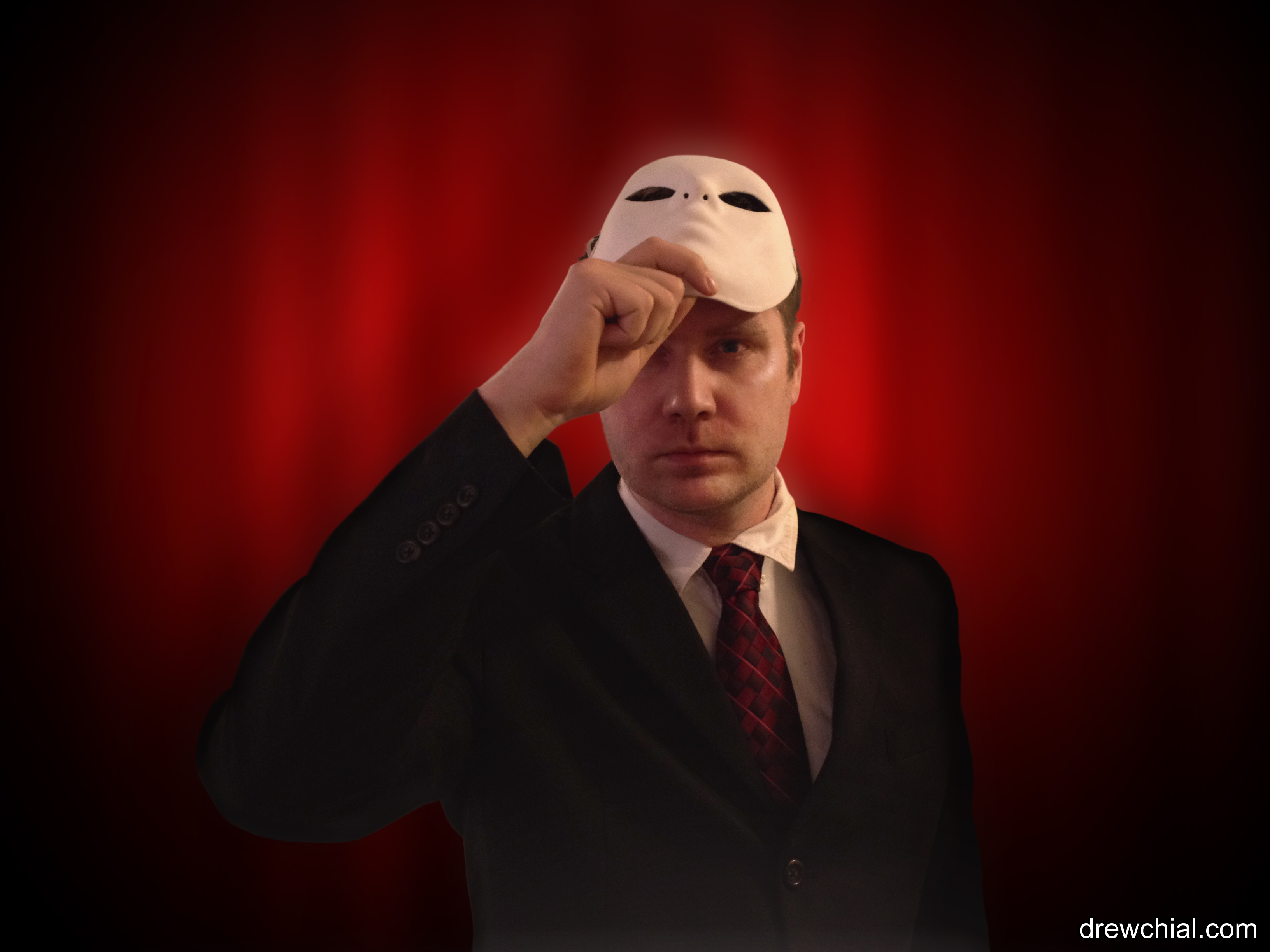
Internal monologues can take us beneath your hero’s mask
Sometimes Telling is the Best way to Show
Writers are told showing is preferable to telling. If given the option to reveal a character trait in a scene or through a narration, we’re supposed to write a scene. We’re told that narration is a form of telling that cheats the reader’s imagination out of its contribution. Writers shouldn’t ask readers to take the hero’s word for it, readers need evidence.
Subtext is the preferred tool for illustrating what a character is thinking through their actions, a way to launder information to the audience without the other characters noticing.
On the surface, your romantic leads sound like they’re arguing over which grocers they trust with their business, but they’re really talking about an entirely different set of trust issues. The scene isn’t about either one of them being embarrassed by a food seller’s practices, it’s about the couple’s mutual fear of being hurt.
There is a way to use telling to show. If a character’s thoughts are in stark contrast with their actions, it helps to run commentary over their scenes. Watch an episode of Dexter on mute and it’ll look like the title character is a working stiff who loves his family, until he flies off the handle and murders someone. Dexter’s internal monologue reveals his “dark passenger” lurks behind his every action. He makes the subtext explicit because he knows we won’t catch it.
If your character is a sociopath, they might not emote enough to reveal their motives. They could have a working knowledge of poker tells, they could keep their expression in check.
Characters are allowed to be shrewd with each other and outspoken with their audience. Their high society world might have them on their best behavior, but they can be shamelessly crass with the reader. We forge an intimate bond with characters who let us peek beneath their social graces and tell it like it is.
Reveal as much of the character as you can through their actions, but don’t deny them the occasional brazen declaration of their feelings.
Internal monologues are effective in moderation. Let them flow with the plot. Let them riff off of ongoing scenes. Don’t let them derail the action. If a chapter reads like a journal entry you’ve gone too far into telling territory. If you ever want to see a film adaptation give the director something to put on screen. Sometimes it’s better to put your lead’s internal monologue in their mouth. Give them one good friend to gossip with, so they don’t have to talk to themselves.
We need to see more of your character than they’re willing to show the world
Let Your Characters Gossip with Your Reader
In his book Robert’s Rules for Writing, Robert Masello says, “One of the greatest virtues of gossip is it gives us a chance, in a casual, nonjudgmental format, to check our own proclivities and attitudes against everybody else’s.”
Is it wrong to bully phone support into doing their job right? Do other people have scripted excuses they give to panhandlers? Does anybody else have friends who live-tweet their panic attacks?
We all want to know if we’re the only ones who do what we do or if our actions are part of a universal human condition.
As much as eavesdropping and observations can help your writing, so can accounts of other people’s wrong doing. The trick is to capture the spirit of these gossip sessions without quoting them verbatim.
It’s good to reveal characters’ relationships through scenes, but the medium allows them to gossip with the audience, to confirm hunches without the other characters knowing.
Why not give our leads a little too much wine and let their tongues hang loose?
Let them say things like, “How long have I been with my husband? Long enough to experience his entire sexual spectrum, from his premature ejaculations to his inability to perform.”
From scene to scene, this character’s mask tells the world they’re satisfied with their marriage, but we know different.
The narrator cuts us in on a dramatic irony, unknown to her husband. This insider information tints how we see the couple’s interactions, it foreshadows tragic outcomes. We get to chuckle at the false assumptions others make about the state of the narrator’s relationship, because we’re closer friends.
There are subtler ways to get this effect, but sometimes giving your audience a peek beneath your hero’s mask is the most entertaining one.
My favorite first person stories are littered with moments where the hero says something so shameless it makes my jaw drop, where I think, “I can’t believe they’re trusting me with this information,” where I mistake them for a real person.
It’s important to ground your story, to show as much of your character as you can, but indulge in telling what they’e thinking every so often.
Albert woke up in a hospital gown, on the floor of a small white cell. Rather than try the door, he sat up in the lotus position, waiting for the world to boot up.
Rubbing his eyes, Albert looked to the fluorescents, then to the shadow cast by the mattress. The brightness didn’t shift. Smoothing the pillowcase, he waited for the white balance to change. The fabric stayed beige.
Albert tapped his temple. When the H.U.D. didn’t show, he tapped it again. This had happened before he just had to remember how he’d fixed it.
Pinching the air, Albert waited for the search field to appear. The memory interface drew a blank. There were no folders, no windows, not even a floating pinwheel of death.
Turning around Albert wasn’t shocked to find a wall length mirror, but rather what he saw there. The lights in his eyes had been reduced to two tiny sparks, the same bland color as the florescent on the ceiling. There were no notifications, no pending messages, no emoticons. This was the first time Albert had seen the natural color of his eyes in a long time. The windows to his soul were wide open and what he saw was unsettling.
Despite the size of his cell, the world seemed so much larger than it had before.
Dr. Locke entered the viewing room behind the mirror. “What do you think?”
Dr. Walton shrugged, “He’ll be crying out for tech support in about five seconds.”
Submitted for your approval a radio play of sorts; a conversation between a pilot and the passenger that’s taken him hostage. One part drama, one part essay, and one part rant. All three fit the scenario, because the stowaway is the captain’s depression, and their argument is internal.
This was originally posted under the name The Depression on My Shoulder, but since the gremlin metaphor factored in so heavily I changed it to reflect the Twilight Zone episode that inspired it.
I’m always looking for new ways to articulate what it’s like to function with depression. Thank you for listening and passing the piece along.
It takes a lot of positive reinforcement to support a writer’s ego. Flattery fades, while words of discouragement echo. It’s not that we don’t know how to take a compliment, it’s just that we lie for a living and we’re skeptical of everyone.
Praise for our writing feels like a put-on, something that dissolves upon cross examination. “What was your favorite part of my novel? What did you like most about the characters? Did you even finish it?”
Harsh criticism feels genuine, because it confirms our suspicions. “I knew that story came too easily. I should’ve outlined more. I should’ve shown it to more beta readers.”
What writers aspire to do is hard. We’re a generation trying to launch careers on Amazon while our competition gives everything away on Goodreads. It used to be that no one was buying what we were selling, now no one is taking what we’re giving.
One bad reaction invalidates a thousand compliments from family and friends, who we suspected were only feigning an interest to spare our feelings. A stranger’s insults resonate, because they have no stake in our wellbeing.
I can still quote the first negative comments I got online. They came from a message board where I’d previewed a few poems from what I’d thought was a collection worth publishing.
The first response read, “If you have a book coming out, then I’ll eat my hat.”
Enter the Anti-Muse. At the time, I had no idea how gentle he was being, that this was him on his best behavior. As I continued to share my work in public forums, the two of us became very familiar.
The Anti-Muse believes his tastes are universal. If something isn’t his cup of tea then the person who made it ought to shuffle off this mortal coil. It’s not enough for him to dismiss the author’s spark of inspiration, he needs to suck it right out of them.
Rather than leave others to separate the wheat from the chaff, the Anti-Muse burns the field down, planting seeds of doubt to spare the world from another crop of poets, bloggers, and self-publishers. When a budding author asks for advice, he tells them to quit. The Anti-Muse prides himself on his ability to quell artistic ambition.
I remember those first harsh reviews more than what I’d shared. That’s the problem with the Anti-Muse. He likes to linger.
Living with an Anti-Muse on Your Back
Once the Anti-Muse gets under your skin, he sets up shop, stirring up intrusive thoughts, flooding the imagination with bad memories. He needs your self doubt on hand so he can reference it at a moment’s notice.
The Anti-Muse has you writing slow, editing as you go, making you so self conscious about what you’re working on, you’re forgetting crucial details about the story to come. He has you overworking for simple statements, second guessing every line of description.
At first you worry your descriptions are too poetic, then you worry your verbs aren’t evocative enough. You use exaggerations to add emotional weight, catch yourself doing it, then resort to procedural accounts like you’re writing a police report. Your purple prose turn beige.
The Anti-Muse has you over researching your subject, then wondering if your dialogue is too technical, as if you dropped all this knowledge just to prove your knowhow. Then he has you gut every plot line that required any level of expertise.
When your imagination suggests a bold new direction, the Anti-Muse keeps you pressing on a familiar one. You play it safe, making sure everything you write feels familiar. Your characters speak in tired clichés, not because you lack an ear for dialogue, but because you lack the confidence to write your own.
Rereading your result, the Anti-Muse has you wondering if you should even bother editing. That’s his function. He’s a demon, sabotaging creative endeavors until the artist is ready to throw the towel in.
Dismissing the Anti-Muse
The good thing about encountering the Anti-Muse online is that he makes himself easy to identify. Like a desperate lawyer who knows the law isn’t on his side, the Anti-Muse makes appeals to emotion. He hates your art without offering a clear reason he thinks it’s wrong.
In some cases the Anti-Muse doesn’t know enough about the medium to offer constructive criticism, literary theory eludes him, he tears you down, because he doesn’t know how to tell you what to fix. He may not know art, but he knows what he hates.
In other cases, the Anti-Muse knows too much, but refuses to share his wisdom. He’s failed to make it on his own, now he resents anyone with similar aspirations. If he can’t be successful, why should anyone?
Either way, the Anti-Muse’s hostility is easy to dismiss, because you know there’s no sense in reasoning with it.
When I’m online, I tune the Anti-Muse out at the first signs of name calling, profanity, or the words “Sheesh” and “Bro.” I don’t put a spotlight on him when he’s heckling, because I know he only speaks in zingers.
Exploring forums on writing, there isn’t a day that goes by where I don’t see an angry know-it-all, who is only there to put newbies in their place, trash talking like the conversation is a match of Call of Duty. Examining their comment history, I find they’re terminally toxic, self-congratulating, flame war veterans.
Some people come across as the Anti-Muse by accident. They know their stuff, but refuse to cushion their candor. They’ll grade your writing, without a professor’s kindly classroom manor. They don’t have the patience to pay you compliments. They spot problems and dive right in.
Before you go dismissing critics based on their tone, see if they’ve gone to the trouble of citing examples. Did they use terms that seem like foreign jargon? Look up their lingo to see if they touched on tropes you use too often. Did they give suggestions for taking your story in another direction? If they hadn’t come off as smug, would you listen to the advice they’ve given?
Every screenwriter that came to speak at my school said the same thing about getting notes from producers: if a suggestion was based on an abstract feeling, the screenwriter ignored it. If a producer touched on something specific, their advice was always considered.
When it comes to taking criticism, developing a thick skin isn’t a writer’s only responsibility. Developing an ear for good feedback is more important.
A critic’s ability to articulate is what separates assessments from reactions.
“No one cares about you, so why the hell would they want to read your memoir?” Isn’t feedback worth paying attention to.
“Every character speaks with the same voice, same dialect, and same pop culture references. You need to make them more distinct so we know which one is talking.” Is feedback you can use.
Just remember, your work will never be universally loved. You will always be a hack to someone. Accept it and keep writing.
There’s a reoccurring phrase characters on Lost always shout when someone tells them that something is impossible:
Something about that stubborn declaration has always resonated with me. I find myself thinking it, every time someone tells me there’s no future in fiction, that I shouldn’t even bother, that I should leave the storytelling to some old Hollywood producers recycling the same franchises year after year.
I’ve received a lot of complaints about the howling translucent entity that’s taken up residence in the emergency wing. Based on the consensus that she is in fact a banshee, I’ve taken it upon myself to do some Wikipedia research.
In all my reading, I’ve found a banshee’s primary function is to warn of an impending death. Now that revelation must seem blood curdling to a family in an isolated cottage, but here in the ER she’s just redundant.
The way I see it, those mob goons buried one too many bodies in the forrest, and this banshee followed the crime wave back into the city, from meth factories to dark allies, until she hitched a ride with a couple of EMTs. She’d been orbiting the vortex of death until she got sucked into the big black pit of it.
She’s our problem now: wailing down corridors, bleeding through operating tables, distracting surgeons and horrifying patients, but what if she could be our solution?
My proposal is simple: if this apparition knows which patients are about to meet their end, why not make her part of the triage process? If a patient is doomed, there’s no reason they need stay on our list.
Until now we’ve treated patients based on the urgency of their issue, but if we’re absolutely certain there’s nothing to be done, aren’t we morally obligated to move on? If the banshee’s never wrong she’s not a pest, she’s a Godsend.
Instagram finally has some competition: an image sharing application programed by demons, setting out to torment users through touch screens, cursing cameras, and casting voodoo onto viewfinders. Beauty is in the eye of the beholder, this photo viewer sees exactly what makes users so impure.
This is an invitation to hear a sales pitch from another dimension. A place where the technology we take for granted takes more than we bargained for. A place of vanity and disappear. Tune in, because the advertisement you’re about to listen to is coming straight from the Twilight Zone.
Writing for the web, I find it difficult to return to long form storytelling. Maintaining an online presence, my short stories always feel more relevant to hot button issues of the day. Working on a novel, I don’t have the instant gratification of ‘Likes’ and comments.
In his book On Writing, Stephen King recommends churning out a draft in three months. He says, if you wait any longer you’ll lose momentum. For writer’s trying to woo an audience on social media, this time frame is tough to maintain. Blog entries and short stories are speed bumps on our novel’s journey.
Returning to my work in progress, I’m often stumped. The characters aren’t as fresh in my mind. I know where the story is supposed to go, but the direction doesn’t seem as interesting. There’s a writer’s blockade around my inspiration. King’s curse comes true.
Usually I’d just give up and move onto the next bright shiny idea, that was before I’d stumbled onto a method to revive my manuscript. Now, rather than stick to my original outline, I give myself something new to look forward to. Not a crowd pleasing triumph, but a problem in need of solving, a plague on my characters’ houses. A big terrible event on par with George R.R. Martin’s infamous red wedding.
This new tragic twist wouldn’t betray the story, but it would be shocking enough to jump start my interest.
The Mind Explosion
Make a Bad Situation Worse
Rereading works in progress, I look for seismic activity. These tremors take the shape of character traits, details I’d put out there to make the character seem more real.
In The Book of Mirrors, I made Austin, the hero, a troubled teen who’d grown up into a successful author. For flavor, I mentioned that she used to have a compulsion to pluck out her hair. I wasn’t planting anything in the grand scheme of things, but when I got stuck something about that character detail became appealing.
In the story, Austin is brought on to ghost write a draft of a forged diary. The diary is supposed to be a cautionary tale to scare teenage girls away from sex, drugs, and the occult. The problem is it’s been stitched together from the real experiences of a dozen other contributors, each one with a background similar to Austin’s. This Frankenstein’s monster journal is so effective at drawing out the reader’s empathy, it gets under the skin of anyone who works on it.
I got stuck trying to figure out the best way to visualize Austin’s descent into madness. She’d spent the story writing in a mirrored room, a place her benefactor said would help Austin reflect on her life. I figured, he’d return to find she’d broken the mirrors and cut herself with the shards, but as I got closer to the scene, I felt like it was a copout, a cheap horror gag I’d seen several times before.
I was about to put the piece on the back-burner when a little voice inside of me said, “Wouldn’t it be terrible if the benefactor returned to discover Austin had plucked herself bald?”
My initial reaction was, “That somehow seems more insane than more traditional forms of self mutilation. If she’s that far gone, how will she come back from that?”
The little voice whispered, “Are you really sure you want her to come back from that?”
Those signs of seismic activity, I’d written subconsciously, steered me toward the emotional volcano at the heart of the story. All I had to do, was listen for the tremors and let it flow.
Mamet’s statement breaks down into three concepts: Goal, Motivation, and Conflict. If every character is motivated to act on their goals, there should be conflict, especially if their goal isn’t compatible with anyone else’s. This is how scenes reveal characters, advance the plot, and tip the scales of hope and dread
If the scale is tipped too far toward hope for too long, not only will the audience lose interest, so will you. If it’s tipped too far toward dread the story will be emotionally exhausting, to read and to write. The trick is finding the right balance, to create just enough tension to keep you and your audience engaged until the end.
Not everything that can go wrong in your hero’s life should go wrong, but your reader ought to think it’s a possibility. They need to believe you are a cruel God and that yours is a harsh reality.
I don’t use every tragic outcome that comes to mind, but I foreshadow as many of them as I can. This way, a happy ending feels like a well earned surprise. Trick your audience into thinking you’re telling a tragedy, then give them a victory.
God might forgive people in the moment, but writers should wait until the third act to decide their character’s fate.
I can come back to stories that I’ve sat on because I write with a loose plan, leaving space for bad shit to happen. Just as stories are born from “What if?” questions, so are plot developments. I ask myself, “What if this terrible development upset my hero’s plan?” If I decide the idea is too harsh, I dial it back and it becomes, “What if I allude to the possibility of this terrible development? Now, how do I prevent it from happening?” Either way, I add to the tension.
For me, so much of writing is tricking myself to press on. If I can keep myself at the edge of my seat I’ll keep going, if only to find out what happens.